Showing posts with label moderation. Show all posts

Sunday, 11 November 2012

How to increase your will-power!


In this fantastic presentation on will-power, Kelly MacGonigal gives some great insights into how we can manage change and manage will-power.  I feel that four of the five recommendations can help people immediately, and the first one she recommends will be the result of taking more control over your drinking.

Brief introduction

The Devil and the Angel.

Classic description of temptation, with the devil telling you to ‘go on, order that next drink’ and the angel replying ‘hang on, it’s already nine o’clock, you’ve got work tomorrow etc’.  And in a way this is a useful metaphor for how the brain works. 

The Devil Brain (Seth Goth calls it the lizard brain - related to why we don't do great work)

The old part of the brain wants immediate gratification.  It lives in the moment and its primal instinct is survival. When we lived on the grasslands of Africa, we took whatever food came our way and enjoyed sex when it was available.  This kind of thinking increased the chances of the survival of your genes then.  Traditionally, people thought of this brain process as hedonistic but Kelly puts a new spin on this.  She puts it this way, people are not getting pleasure from doing drugs, drinking too much, eating non-stop, they’re getting relief from ‘want’. 
It was an asset in the grasslands of Africa but now-a-days with cheap food, cheap booze, TV, internet etc, immediate gratification has become a liability.

The Angel Brain

This is a newer part of the brain.  It’s more long term thinking and can control impulses to do things, for the long term good.  It allows us to drink socialably but helps us stop before we will ruin tomorrow.  It helps us say no.  It helps us do the right thing.  It’s the brain we need for the modern world but often it loses out to the devil brain.

The Five Willpower enhancers;

1.      Sleep, exercise, eat well and meditate.

2.      Forgive yourself

3.      Make friends with your future self

4.      Write about how you will fail

5.      Surf the urge (it’s not pleasure, it’s want)

Sleep, exercise, eat good food and meditate
For me, this one is difficult to do when you’re drinking too much.  Yes, drinkers exercise, they can eat well and some meditate but in general, drinking goes against these things.  It disrupts your sleep, makes you feel tired and sometimes even rotten.  Certainly for me, drinking was a drain on ‘doing the right thing’, especially the day after.

I feel that the other four practices will have more of a positive benefit to cutting down and this one, is what you get for reducing your drinking.

Forgive yourself. 
If you’re quitting or cutting back, you’re are likely to suffer from a relapse.  Studies, find people who are easy on themselves after a relapse did much better at their habit change then people who turned in on themselves.
I found this to be true.  When I went to Taiwan in January (2012) I got drunk like the old days.  There was a slight difference, I was more aware of what I was doing but I didn’t do much to reduce my drinking.  I realise that this wasn’t what I wanted but I didn’t seem able to do anything in Taiwan, so I decided to write it off.  I allowed myself to drink in Taiwan but afterwards I would address what went wrong and take action.  It worked.  It turned out to be just a two week blip.

Make friends with your future self. 
Studies have found that people who connect most closely with their future self(s) were much more likely to succeed in changing a bad habit than people who felt their future self(s) were different people.

Exercises used to help people connect more closely with their future self, included;

·        Writing a letter from your future self, thanking you for the action you had taken to develop a better habit.  You can write how your life is so much better for the action you took.

·        Imagine your future self doing some routine tasks.

Write about how you’re going to fail at your habit change.  
In studies they found that very positive images of you succeeding worked a little bit better than doing nothing.  But writing about how you’re going to fail made a bigger difference.

Why does this help?  I believe that this helps you understand how your bad habit works.  What triggers it?  When your failure is like to happen? Who are you with? Etc.  You predict what’s going to go wrong and then you notice how accurate your prediction is.  You refine it and get to know the ins and outs of your habit.  It helps your self-awareness and ultimately, it’s this self-awareness that helps you change.

Surfing the urge.
Take a smoker for example;  he’s dying for a fag but instead of giving into the urge, he;

  • Focuses his attention on the carving.  What does it feel like?  Where is the feeling?
  • He knows that the carving is like a wave and will go away.  He knows he can surf this urge.  He can take deep breathes.  The urge will eventually go.
I loved the presentation Kelly gave in this Authors@Google series.  I hope you find it helpful too, especially with the Xmas party session coming up.


Friday, 5 October 2012

Upcoming Will-power series


We are already in October and Christmas is fast approaching. 

Christmas is a time for cheer or so they sell it. More like drunken nights and rotten hangovers, if my memory serves me right.

Many of us increase our drinking over the Christmas period, because there are many more opportunities to do so.  There are work parties, friends and family get togethers, and in general we have a little more time (less to do at work and some holidays). 

We also increase our drinking because it’s expected of us, this is especially so for people with a reputation for drinking.  If you don’t live up to your reputation for drinking, people tend to think something is wrong.  (John, what’s wrong, why don’t you have a drink?  ORANGE JUICE!  You don't have to drive tonight, do you?  Come on John, get lively, here's a drink for you.  Etc).

So to help you get prepared for the Christmas period and to avoid an increase in your drinking and possibly a decrease, there will be a short series on will-power.

Will-power series

1st – review of a Google Talk by Kelly McGonigal.  In this talk she highlights five things that we can do to improve our will-power/self control.  I’ll provide a short review of the highlights from her talk and how drinkers might use these.

2nd – Environment >Will-power.  The focus will be on how we can change our environment so that it supports a more moderate approach to drinking.  This is very applicable to the home.  We also look at ways of automating decisions instead of using will-power, which can be used for social occasions where you have little control over the environment.

3rd – Summary

I’ve learned some things about will-power which I wasn’t aware of before.  There’s a lot of talk of will-power as a limited resource.  In layman’s terms, every day we have X amount of will-power and making decisions, communications and ‘self-control’ uses up your will-power.  So that by the end of the day, many people have used up their ‘will-power’ resource and are unable to resist temptation.  It’s a bit more complicated than this and for a fuller review read here.
 
Change of view on Will-power?

I’ve used the BJ Fogg model of habit change, which emphasis behaviour change and use of triggers over will-power.  I’ve written about will-power before.
Will-power is overrated!
Why drinkers drink.  A look at motivation.
 

But I think Kelly McGonigal ideas will support anyone trying to moderate or abstain from drinking (or to change any habit) and are worth knowing and experimenting with.

More on will-power soon.
Other articles to help you become a moderate drinker

October Challenge


I consider my drinking still to be moderate and I’m happy that my drinking habit is quite stable.  When I’m at home, I tend to drink one or two glasses of wine at a time.  In September, I think I was drinking more often though and to address this, I’ve decided to cut out alcohol for October.  It’s also partially because when I cut out alcohol in March, I felt really good (but I had also started exercising at that time too) and I’m curious to see whether this will happen again.

It also feels different this time, as it doesn’t feel so much like a challenge.  In January, I drunk like my old self and March was only a short time after that, so it felt like something I must do.  This time, it feels quite easy not to drink.  Well, it’s only been four days so far.

I have one exception for drinking in October and that is, if my friend from Taiwan comes over, I’ll have a beer with him.  This exception is in place because the last time he came over was in March and I think he was a little disappointed that I didn’t share a beer with him.

Monday, 3 September 2012

A year ago today

Officially, the Moderate Drinker has been on the Moderate Drinking road for a year.

On the 3rd September 2011 I made the effort to cut down to two glasses of wine and then on the 4th Sept 2011 I came up with 'Just one glass per night'.  That was the start.  Moderating at home was surprisingly easy but at parties and pubs it took some more effort.

I got sadly drunk for two weeks in January when I went back to Taiwan for a visit.  I used to work out there. But since then I've been moderate again both at home and in the pub. 

Cutting down has had some great benefits;

  • Feeling good on both Saturday and Sunday
  • No hangovers (except in January)
  • Generally feel happier when I'm not drinking
  • Don't feel the complusion to drink more and more
  • More motivated to make other changes in my life.
  • When you're sober, you realise drunks aren't so funny
Things are far from perfect but really cutting down on drink has made my life better.

Related articles

Why don't more heavy drinkers moderate?

How to be a moderate drinker?

Wednesday, 11 July 2012

Who’s the expert on alcohol?

Doctors, psychiatrists, nurses, addiction workers, alcohol specialists?

Perhaps it’s you!  You probably know more about hangovers, how drink affects you, the ‘drag effect’ it has the day after, how being extremely drunk feels than most of the experts mentioned above.  You know this because you have experienced it directly.  Yes, some of the experts have been drunk, but have they been drunk as many times as you?  Do they know more about the effects of alcohol on you than you?

In Malcolm Gladwell’s book, the Outliers, he talks about the 10,000 hour rule.  This rule states that you need to practice for 10,000 hours to become a master at something.  This is not to become an expert but a MASTER!

So let’s be conservative.  Let’s have a baseline of ‘a bottle of wine’ (or 4-5 pints of beer) for being ‘drunk/under the influence'.  Perhaps this takes four hours to drink.  Including some disruption to sleep and the day after effects of alcohol, perhaps we can add another four hours.

This is the baseline.  There have probably been times when you drank for much longer and in larger amounts.  Obviously the day after effects of these sessions also last longer, but we’ll keep the drunk baseline at 8 hours.


Times the number of times in your life you’ve been drunk with 8 hours.  Are you a master yet?

I drank a lot for a long time.  My calculate come out as roughly 3,900 times I’ve been drunk in my life (perhaps it’s a bit lower than that? It seems obscenely high) but that gives me 31,200 hours of experience of getting and being drunk.  That is Zen mastery.

Even if you’re not a master yet, you are still an expert.  You know how alcohol effects you.  You know more than most doctors how you feel when you’re drunk.  You know a hell of a lot about the day after effects of alcohol.  Use this knowledge.  Is it what you want in your life?

Answer the following questions;

When you are drunk, how does alcohol affect you?

In a good way?

In a bad way?

What do you do when you feel bad whilst drinking?

How does alcohol affect you the day after?

Getting up?

Motivation?

Energy?

How often are you affected by alcohol the day after?

You know a lot about alcohol.  Use this knowledge to motivate you to drink less.  It’s not normal to wake up with a hangover.  It’s not normal to feel shitty for a morning or a day after drinking.  It’s only normal to you because you’ve made it normal.  It doesn’t have to be this way.  Cut down and be a moderate drinker.

Change Your Life - Bonus Reasons

Monday, 25 June 2012

Imagine How Your Life Could Be as a Moderate Drinker

A New Start

You wake up with a smile on your face and you immediately hug your lover.  You feel the warmth of your lover.  You feel love and you feel wanted.  You start the day with a smile and with love.


When you getup, you stand tall and thank god or your lucky stars or whatever, that its Saturday and that it's your day. 


You go to the window and look out.  You see a beautiful day awaiting you.  You feel excited and look forward to your day.  You just can't help but smile because it's your day! 


Reclaim your mornings!  Reclaim your weekends!  Reclaim your life!


Be a moderate drinker.  And stop living under the influence.


Articles to help you change;


Monday, 28 May 2012

Learn at Home – The Art of 'Stopping' after one glass


Why doesn’t good advice work more often?  What’s the human trait that gets in the way of habit change?  And what’s a simple way of addressing this trait?

The home is the ideal testing ground for changing habits because you have control over the environment.   When you change the environment, behaviour changes can become much easier.


A few years ago


I’d wanted to moderate my drinking for a long time but I didn’t find a way of doing it. I came across a key bit of advice for people who want to moderate their drinking;


“Think before you drink.  Decide how you’re going to drink before you start and when you’ll stop.” 


Whilst this is good advice, it does overlook the ‘how’ and a condition many of us suffer from.   The classic image of someone trying to change a habit (someone on a diet, stopping smoking or cutting down on the drink) is someone struggling with ‘carvings’.  They fight against themselves, sometimes winning and sometimes losing.  I hardly ever got to this stage because I simply forgot to ‘think before I drink’.


Forgetting was my main problem with changing this habit.  But why did I forget? 


Well, I think, it’s partly because we have a rush of thoughts that are pro-drinking before we start drinking.  If we’re going to meet friends, we’re probably thinking many things like; how are my friends? What stories can I tell them about me? What news do I know that they don’t?  How can I make this night fun? etc.  (Many of these thoughts might be pro-drinking, if we have beliefs such as ‘I’m more social when I drink’, ‘drink makes things more fun’, ‘I talk more when I drink’ etc.)


We also lead busy lives.  Our lives are full of information, which complete for our attention and keep us preoccupied.  There could be issues at work, with the family, we might be busy with our social networks and the environment is getting filled with information too (ads especially).   With all this information going on, it’s not surprising that we can’t remember to ‘think before we drink’.


Accept that we all ‘forget’ because it can be addressed.  This is especially easy in the home.


A trigger gets you to automatically do something.  In drinking, a classic trigger is when we finish a glass of beer/wine/whiskey.  What do we do?  We fill it up again.  And if we don’t fill it up, people will ask you ‘Do you want a drink?’ or ‘Is everything ok?’   People are incredibly uncomfortable with empty glasses.


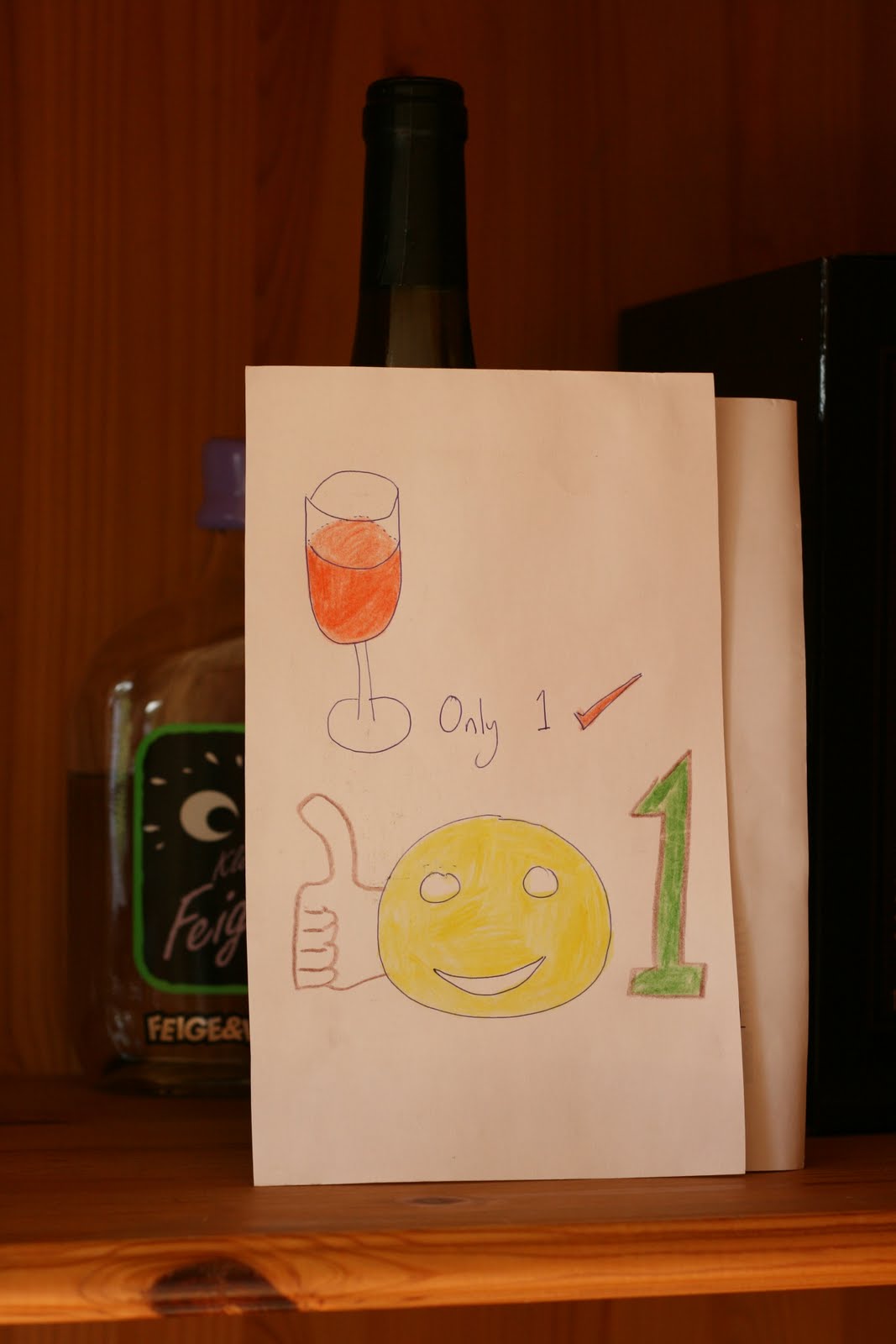
To address ‘forgetfulness’, the easiest way I found was to put a reminder by my wine bottle.  This put the message ‘think before you drink’ in the right place.  I also saw it at the right time. 


When I saw this,  my thoughts went like this.  I’m going to drink just one drink.  Why?  Because I won’t get a hangover tomorrow, I’ll feel fine and energetic, and I won’t be a drunken idiot tonight.  Drinking one is healthy.   It’s easy to do.


And it was.  Once I thought about ‘what’ and ‘why’ before I started drinking, the change was easy.  The trigger also meant I did it every time.  Consistency is what changes habits and triggers make you consistent.


I stopped using the triggers after about two months because I automatically ‘think before I drink’ now.


Friday, 11 May 2012

Why do we drink? Let’s learn from the Advertisers

Understanding why we drink is an essential key to changing the way you drink.  Many of the ‘whys’ are based on myths about alcohols;  Alcohol relaxes me, alcohol makes me more social, the more I drink the better I feel, etc.   People like Allen Carr believe that tackling the ‘drivers’ of drinking removes the desires to drink.  Allen Carr basically turns reasons to ‘drink/smoke’ into reasons not to.  
 
Why learn from the Advertisers


Because they’re expert at influencing behaviour and using ‘positive’ association with the product they’re pushing.
Sorry, I'm having terrible embedding this video, so there's just a link.
These are my thoughts, feel free to adds yours too.
Advert 1


It makes things different.  Something unexpected might happen.  You’ll be living but with a different tune – fun because it’s different.


Advert 2


Beer tastes great and it’s quenches a thirst.  It’s related to sex, the tongue and the couple snogging. It’s related to the night and excitement.  The swimming with the ice – it changes your state and refreshes you.


Advert 3


It’s a manly thing to do.  Men and beer relate.  When men and beer get together, you can relax and have a good time.   The pub is a place for a man.  If you drink and you’re a man, you’re still a rebel – young at heart.  You might be married but if you're a real man, you still drink beers with the boys.


Advert 4


Beer is better than a beautiful woman.  It taste really good too.


Advert 5


Something magical happens when you drink.  You become very creative and a carnival atmosphere prevails.  Drinking beings the community together.  Everyone is happy when they drink.  It’s ok to hijack a beer lorry, if you’re hijacking it for the community use. 


Advert 6


Drink beer if you’re a man.   (nice play on the ‘politics of rounds’).


Advert 7


Beer makes you dance and brings out your hidden talents.


Advert 8


Beer solves the biggest of problems, even drought.


Advert 9


Australia is great because of Bundaberg Rum.  The UK sucks and because we all like our alcohol, we all want to move to Australia for Bundaberg Rum. 


Advert 10


Beer is epic!  It’s classical and makes us do great things.

I'll follow this up with a video of Allen Carr talking about his method for giving up smoking.  It's equally applicable to cutting down or getting up drinking.   And attempt to tackle some of the reasons these ads give us that 'drinking' is 'great'.
Any ideas about why we drink and thoughts on the adverts, please add a comment.

Monday, 7 May 2012

Why Don't More Heavy Drinkers Moderate?

Who’s this for;

Heavy drinkers who want to cut down on their drinking but so far haven’t found a way.

Moderation would be easier if we did the right things.

If you want to moderate, do what moderate drinkers do.  They drink in a way that’s different to heavy drinkers.  Learn some of the skills that moderate drinkers have and your drinking will become more moderate. 

Unfortunately, this is not what a lot of heavy drinkers do.

Why don’t more heavy drinkers moderate?

You wake up with a steaming hangover and end up doing nothing the whole day.  You feel like shit, not only because you’re hung-over but also because you’ve wasted another Sunday.  You really want to cut down.  So you stop drinking for a week. 

End result.  You feel much better but when you start drinking again you’re drinking like you always have.  And then you forget about moderation until the next time you drink way too much.

Drinkers who want to moderate confuse ‘abstinence’ with ‘moderation’.  Abstinence and moderation are two different things.  They are two different skills.  Abstinence is not drinking.  Moderation is drinking small amounts which are not harmful to the body.

Abstinence

If your goal is to moderate your drinking then abstinence at best can provide you with some breathing space.  It’ll detoxify your body and you’ll feel healthier.  But abstinence by itself is unlikely tomoderate how you drink. 


You moderate by learning the skills that moderate drinkers have.  These are the skills that will help you cut down.  They work because they give you a new way of drinking.

What are these skills?

·         Learn to stop after one drink.  (I recommend one at first because it’s simple and the effects of the alcohol are light). 

·         Drink water or a soft drink with alcohol.

·         Learn to say to no to alcohol.

·         Understand why you want to drink – then question this.  Most of the reasons we used for drinking are based on myths or misunderstandings about alcohol.

·         Increase the gap between your first drink and your second drink.  Perhaps use a timer or alternate on the drinks i.e. soft drink than alcoholic drink etc.

·         Increase the gaps between every drink you have.

·         Think long and hard about the pain and trouble alcohol has brought you.  You already know that too much alcohol is bad for you.  Use this knowledge.

·         If you go out, start off with a soft drink.

·         Opt out of the round system.

There are probably more as well but if you learn two or three of the above, I’ll guarantee that the way you drink will change and you’ll be drinking less on more occasions.
So if you want to  moderate your drinking, think like a moderate drinker, do like a moderate drinker and the end result, you'll drink more like a moderate drinker.

Thursday, 3 May 2012

How to moderate your drinking – Your ideas

Who’s this for;

People who want to cut down on their drinking but haven’t been able to achieve this yet.

First thing first.

If you want to change something, it’s easier if you understand where you are now. Recording the drinks you drink is a good place to start – Review of Mydrinkaware

Also ask yourself the following questions;

How many times have I got drunk in my life?
Who do I drink with?
What do I drink?
Is the same throughout the night?
Do I change drinks?
Do I always drink the same amount?  If not, when do I drink more; when do I drink less;
When do I start drinking?
Do I drink more in the home or outside?
Where do I drink most?
What do I do when I finish a drink?
What do I feel before I drink?
Why do I drink?

This is visual representation of how I used to drink;


This is how I used to drink some nights. Beer after beer after beer. What can you do to moderate this kind of drinking?

How about this pictures;


Again beer after beer. In this pictures, there are times showing the time between emptying a beer and getting a new one.

Again the question is: What can you do to moderate this kind of drinking? There are many answers!

Also Read

Comprehensive guide to becoming a moderate drinker
Why become a moderate drinker?


Wednesday, 21 March 2012

A Sober Look at Drunkenness

Who is this article for?

Heavy drinkers who want to cut down on their drinking.

How

By becoming more aware of how drunkenness looks, especially from when you're sober. Also by getting photo or video evidence of the affects of alcohol on you.

Why

Because drunkenness looks much worse when you see it sober than when you're drinking


Drunkenness doesn’t seem so bad when you’re drunk. It’s just part of life and perhaps everything is funnier and more acceptable when you’re drunk. I was repeatedly drunk for 25 years of my life but it wasn’t until I was sober that I realise how bad drunkenness can make you look.

I remember on one of my first nights out as a moderate drinker, seeing people’s eyes red up, hearing their speech slow down and finding their fumbling speech more annoying as they became more repetitive. I was surprised at how ‘destructive’ drinking could be. Since then I’ve seen it on numerous occasions and when people get very drunk, it really doesn’t look good. But when I was drinking heavily, I simply didn’t see these things in the same way.

Here are some videos from YouTube on drunk people. I hope you’re sober!


These videos are not for laughing at, though I admit I did laugh out loud a few times. These videos are a lesson. If you wake-up and can’t remember what happened the night before, have hangovers often and regularly get drunk. You’ve probably done something similar many times over. When you’re drunk though, it just seems like a laugh! It’s only when you’re sober that you realise how badly people might be perceiving you.

Possible Method to increase your motivation to drink less.

Research has found that ‘Before’ (and after) photos work better for people on diets or trying to gain muscle than just written diaries or goals. Researchers believe that a photograph is more graphic and makes the problem look worse than if it was just in writing.

I believe that photographs and videos could work just as well for people who get drunk often. The ideal times would be when the person is very drunk or hung-over as these are the times that alcohol has its biggest impact but the drinker is least aware of the affect. Video would be great as you’ll be able to see how alcohol affects your movement and speech.

Ideally, the photos and videos should be seen daily and especially when you start drinking.

This is just an idea. It’s not proven but I can remember waking up without knowing what happened the night before and being drunk on a regular bases, but I didn’t fully realise how bad my behaviour was or whether I just made excuses. Also my sober self didn’t have the direct evidence on the effects of alcohol on me, perhaps photos and videos can provide that evidence.

Tuesday, 13 March 2012

Quick update

Mostly Successful

I haven’t posted for more than three month but being a ‘moderate drinker’ has largely been successful.

Going Backwards

I went backwards a couple of times. I got drunk a couple of times over the Christmas period but in general I drank much less than I normally did at Christmas.

The biggest step backwards was in January, when I went to Taiwan for two weeks. I used to live in Taiwan and it was great catching up with everyone. Unfortunately, I drank like my old-self, perhaps with a tiny bit more restraint. I got really drunk a couple of times and I was sick the after day on one of those occasions.

Still, it was self-contained to those two weeks in January. Since coming back, I'm back to being a moderate drinker. Stopping after one or two glasses of wine and I’m currently not drinking for the whole of March.

What went wrong in Taiwan?

I was going out a lot and drinking in very social situations. In Taiwan, a lot of the time, I was drinking whilst eating, but drinking a lot. There was a big variety in places and also in people I was drinking with. The main thing that went wrong was that I wasn’t saying ‘no’ to a drink. Another thing, I didn’t take a bottle of water with me, when I went out.

What I need to work on.

I definitely need to say ‘NO’ more often and perhaps have a rule to always start off with a soft drink.

In Europe, to get used to drinking 'non-alcoholic’ beer. One of the problems I have with this is that it’s usually the same price as ‘beer’. I need to get over this and see that a ‘non-alcoholic’ beer is a way of being with the ‘crowd’ and being healthy.

What I’m doing now.

Currently, I’m taking a month off from drinking for the whole of March. Whilst, I don’t think ‘abstaining’ helps much with being a moderate drinker, there is one thing that you must do in social situations and that is say ‘No’. Last weekend and this weekend, I get the chance to say ‘no’ to a drink.

Wednesday, 23 November 2011

Three Gear Drinking Brits

This article is for;

People who drink too much and want to cut down.

Reading this will give you;

You’ll realise that British drinking patterns are just habits. British drinking habits might be unhelpful and limited but they can certainly be changed. Moderate drinking is a skill and like all skills it can be learnt by most people.

Brits and their three gears of drinking

0 (neutral if you like) – Don’t drink.
3 – Drink fast
4 – Drink until you’re very drunk.

If this was a car, you wouldn’t be very happy. It’ll get you into a lot of trouble and you’ll be making an ass of yourself most of the time you’re driving. Same with drinking, you either be fine, when you’re in neutral or when you do drink, you risk the chance of hangovers, missing much of your weekend, feeling bad, sounding slurred, insulting someone you didn’t want to or even getting into trouble with other people. Drinking with three gears isn’t great and yet many British people drink this way. I did for twenty five years and the majority of people I know who drink, drink this way too.

Why are we so bad? Culture, perhaps? Weak minded? Peer pressure? The causes could be debated forever, the end result is that many of us only drink using third and fourth. We don’t drink using gears one and two because essentially, we don’t practice them. When was the last time you stopped after one? When was the last time you started with water? When was the last time you ordered a jug of tap water with your round?

What are gears one and two?

Perhaps;

1 – Drink one or two drinks and stop
2 –Drink two, three or four drinks, with a soft drink starter or alternating between alcohol and soft drinks.

If you can master even one of these gears, your drinking will radically change. They are not difficult skills to master, you only need to practice them to get good at them.

I’ve practice ‘drinking one or two drinks and then stopping’ and for me, this has been my silver bullet. It has changed my attitude towards drinking. I now think before and during drinking about what could happen the next day. If possible, I drink with a soft drink too, to slow me down. The amount I drink now is much lower than before. I hardly ever drink more than four pints at a time. That used to be my minimum.

You don’t have to be a three gear drinking Brit. You don’t have to get drunk every time you drink (check out Scare Yourself with numbers). You don’t need to feel bad about yourself the next day. Take control of your drinking by practicing gears 1 and 2. Once you’ve got these gears, your drinking will change for the better.

Other articles on Moderate drinking

Overview of the Moderate Drinker
Will-power is overrated

Tuesday, 8 November 2011

You don’t become a moderate drinker by abstaining

Who’s this for?

Heavy drinkers who want to cut down their drinking but who don’t want to stop. There are many advantages in moderating your drinking, namely better health, save more money and better relationships with the ones you love.

Abstinence

Abstaining can be great and though I’m not religious I believe that modern society is missing out because we don’t practice lent anymore.

I’ve abstained quite a few times, the longest ones being Feb 09, Dec 07 (India) and Feb 99 (India). Yes, I felt great afterwards and I thought they were worthwhile. They were welcome breaks for my body and my mind. They both felt better for not drinking. But when I started drinking again, I just went back to my old habits. You don’t become a moderate drinker by abstaining.

The skills are different.

Abstinence is mainly about avoidance of drink and saying no.

Moderation is finding new skills that help you handle drink better, like stopping after one or two drinks, drinking a soft drink with alcohol and being aware that drinking too much leads to unpleasant consequences the next day.

Practice the skills, to get better at them.

From my experience the only way to learn these skills is to do them and do them consistently. I found the use of triggers really helped me develop these skills. After you do them consistently for a while, they start to become natural.

Triggers I used


Another possible trigger to use

Drink water with, before and after an alcohol drink. If in the house – use a notice on your bottle of wine (or whatever it is you drink) “One wine, one water”. I feel strongly that the message needs to be with the drink as this helps you get consistent at doing it.

Conclusion

Many people believe that if they stop for some time and then start again, they will miraculously be moderate drinkers. I learnt from experience that this is not the case. Moderate drinking and abstinence are different. You need different skills to drink moderately.

I’m not against abstinence, I think for some people it’s the right choice and even for moderate drinkers a period of abstinence could be good for them. If you abstain from drinking, you will feel better (at least different).

If your goal is to be a moderate drinker, then you need to learn skills that help you be a moderate drinker. Simple as that.

Wednesday, 2 November 2011

Alcohol Diary - 14th - 31st October

Welcome to the Moderate Drinker.

After a busy start to the month, things settled down into a much healthier pattern.

Overall, I’m happy with the way I’m approaching drink. It feels natural to just have one in the home now and I was happy that I took action to reduce my drinking when I went out to the pub earlier in the month.

I'm loving the side benefits of moderate drinking too, especially the additional quality time that I have and I don't miss hangovers!
Overview of October

• 12 days alcohol free
• 10 days - 1 drink
• 4 days – 1-2 drinks
• 3 days – 2-3 drinks
• 2 days – 4 drinks

For November I’d like to increase the alcohol free days and reduce the days with 2-4 drinks. Only problem is that I’m going away to a vineyard for one weekend.

I’m thinking that a month off the alcohol would be good too but I don’t envisage that happening until March next year.

14th - 2 and a half small glasses of wine. Went to a friend’s house for dinner. Drank slowly and left the last glass of wine unfinished.
15th – 1 glass of red wine
16th – 1 glass of red wine
17th – 0
18th – 0
19th - 1 glass of red wine
20th – 0
21st - 1 glass of red wine
22nd – 4 and half small glasses of white wine
23rd – 0
24th – 0
25th – 1
26th – 1 and half small glasses of white wine
27th – 0
28th – 0
29th - 1 glass of red wine
30th - 1 glass of red wine
31st – 0


September Results

Thursday, 27 October 2011

Alcohol - Scare Yourself With Numbers

Since deciding to be a moderate drinker, I’ve become more aware of a few facts about my drinking.

A scary one was that I’ve been drinking heavily for about 25 years. That’s roughly 60 - 61% of my life.

Another scary one is to calculate roughly how many times I’ve been drunk (lets say four pints of beer or a bottle of wine) in my life.

• If it’s twice a week that will be 2,600 times.
• If it’s three times a week that will be 3,900 times.
• If it’s four times a week that will be 5,200 times.

My guess, and it’s only a guess, is that it’s around the 3,900 mark. There have been times when I’ve drank less, but there’s definitely been times when I’ve drank more. That’s scary.

• 3,900 times I’ve drunk so much that its damaging to my brain.
• 3,900 attacks on my liver.
• 3,900 times that my speech has been affected by alcohol (maybe).
• 3,900 times I’ve been affected the next morning.
• 3,900 times before I took decisive action to drink moderately.

Also, another scary number. If I’ve been drunk 3,900 times, then that’s like being drunk every day for nearly 11 years. Now that’s scary.

When faced with numbers like this, I really wonder why I’ve continued to drink heavily for so long. It’s looks ridiculous to me now but it’s helping me to be stronger as I’ve realise the damage I’ve already done. These numbers scare me but they’ve also made me stronger.

Calculate your own numbers. Use equation in Excel.

=25*(52*3) (number in this equation are mine)

1. The number of years you’ve been drinking
2. Weeks per year
3. How many times a week you get drunk

Remember, scaring yourself is pointless, unless you scare yourself into action.

Posts for taking action

How to be a Moderate Drinker

Use 'Triggers' to change your drinking habits

Monday, 24 October 2011

How to be a Moderate Drinker!

Overview

This simple model gives you the tools to adjust your drinking downwards to levels where alcohol is harmless. You’ll also enjoy the day after drinking much, much more and develop new skills so that you can still enjoy a drink and have the confidence to determine how much you want and when to stop.

The Model

People blame their lack of will-power for failing to change things they don’t like about themselves. This pre-occupation with will-power tends to make people a bit short-sighted of what they can do to change their habit. Habit change is not only about will-power, it’s a bit more involved than that. It’s like trying to make a table by only using a measuring tape. There are more tools you can use. Once you use a saw and a hammer, the job becomes much simpler. The same is true for habit change, once you start using all the tools available to you, habit change becomes easier.

BJ Fogg - Model of Habit Change


• Motivation (will-power)
• Abilities
• Triggers

BJ Fogg has said in an interview that ‘abilities’ and ‘triggers’ are more important than motivation for actually creating a new habit.

Motivation

What will you get when become a moderate drinker?

Some of my motivation

• No hangovers
• More quality time
• Peace of mind – 25 years is a long time to have a risky habit
• Lessen the risk of a serious accident
• Healthier
• More focus
• Move on from drunken behaviour (Drinking less has given me the opportunity to see people get drunk and it’s not that pretty. It makes me cringe to think I’ve done that so many times over the past 25 years

Motivation and being a Moderate Drinker

It’s very inconsistent and when I’ve planned to moderate my drinking in the past, new habits didn’t form because I was too inconsistent. It was hardly ever there at the right time and place, which is why I’ve used triggers. When combined with triggers, motivation is much more powerful because it’s there at the right time and in the right place. It has also led to a consistent approach of determining how many drinks I’ll have before I start drinking.

Abilities (new skills)

• Say no.
• Understand how and when you are drinking.
• Stop yourself. (after one, two or three drinks)
• Congratulate yourself when you say no and stop yourself.
• Deal with peer pressure
• Order water with a round/drink.
• Drink water in a pub.
• Disassociate being sociable, having a laugh, feeling open with drink and associate these things with yourself/being your friends.
• Associate hangovers, being down, being lazy more strongly with heavy drinking.

What I love about ‘abilities’ to be a moderate drinker is that none of them are ‘rocket science’. We can all say ‘no’ and we can all stop ourselves at having too much of something. Perhaps, we just don’t do this with drinks.

In Britain, many people drink fast and heavy. They don’t say ‘no’ to having another drink and they rarely stop themselves. Their habits dictate their actions and this won’t change until they start practicing saying ‘no’ to drinks and ‘stopping’ themselves. Once they practice, it’ll become easy. All it takes to get a new skill is practice.

Abilities and being a Moderate Drinker

I decided that at home, I would only have one glass of wine a night. One glass, partly for simplicity, easier to record and also I thought it might be easier to stop when I only have one glass. I used a trigger that basically told me ‘only one glass per night’ and this caused me to think before I drink (I think about the benefits of only drinking one). I was surprised at how easy it was and still is.

It’s now, almost natural to think before I drink. I’ve kept to only one glass per night, except for last Saturday when we had a small dinner party. This think before I drink has extended to when I go out with friends too. I don’t necessary keep to one drink on those occasions but I’m certainly drinking less than before.

Side effects – I’m starting to drink wine slower now, I drink a lot of water with and after drinking wine and I’ve used this tactic in the pub as well.

Triggers

Triggers for your old/current habit

• Looking forward to a night out
• Rounds – keeps you drinking without gaps. Also encourages fast drinking, to be the same as everyone else. In the home, this habit continued, even without the ‘round’ trigger.
• Empty glass – this can trigger someone to fill it up for you.

There are many more.

The important thing about understanding triggers for your old habit is that you’re better equipped to disrupt them.

Triggers for introducing a new habit.

• Message stuck to my wine bottle – only one glass!
• Message by my wine bottle to remind me to celebrate only drinking one glass (celebrate no hangover in the morning and that I’ll feel good then too)

Possible other triggers, which I haven’t used.

• Message that reminds you why you want to cut down. In place where you can see it first thing in the morning and last thing at night.
• Small bottles of wine.
• Limited alcohol supply so that you can only drink one or two drinks.
• Associate buying a drink with also getting a pint of water.

Triggers and the Moderate Drinker

Most of my drinking is in the home and triggers really made becoming a moderate drinker easy. They reminded me ‘why’ I wanted to moderate my drinking and they did it at the right time and in the right place. They kept me consistent at stopping after one glass. This skill is transferable to the pub, where I’ve had a beer and next to my beer is a glass of water. I’ve turned down offers of drinks mainly because I didn’t feel like them. All this has come from being consistent in the home.

Friday, 21 October 2011

Will Power is Overrated!

Overview

Will-power/motivation is not the only key to changing a habit. It can help you decide to take action but it’s the actions you take that are the keys to change. Stop blaming yourself and stop making motivation an excuse.

Commonly said things about failure to change

I lack motivation! Where's my motivation - I don't have any! I'm pathetic! I said that I’d change but I don’t have the guts! I'm too weak! I don’t have it within me to change! I'm spineless!

As a society we seem to have an obsession with will-power, especially our lack of it and we end up staying with bad habits because many of us think we are too weak to change. Where does this obsession come from? Our parents, the boss, the wife, education? Who knows?

But all I know is that will-power is naturally a wibbly-wobbly thing.

Take will-power to moderate your drinking

• Stinking hangover – your will-power is probably 10/10 (a lot of people promise they will quit at this point)
• The worst of the hangover goes away – will-power goes down perhaps 7/10
• Someone calls you a day later. They want to meet-up for some drinks. It’s always fun with this person. Will-power goes down again 5/10
• You read about the damage heavy drinking does your body – will-power goes up 6/10
• You see a funny ad for drinks. It makes you smile – will-power goes down 5/10
• You’re excited about seeing your friend. Will-power goes down 2/10

When you need your will-power the most

It’s usually not there. Many people look forward to drinking, mainly because it’s associated with many enjoyable things – socialising, friends, laugher, going out, relaxing, after work activity etc.

It’s hard to even to think about ‘moderation’ when there’s so much to look forward to. Apparently, your conscious mind can only hold one thought at a time and there’s little chance that will happen if your mind is abuzz.

So stop blaming yourself and stop making ‘will-power’ the be all of habit-change. It’s not.

Next Post

I’ll introduce a Habit-Change model by BJ Fogg that has made it easy for me to moderate my drinking. In his model, motivation is only one of three tools that we can use to change a habit.

Monday, 17 October 2011

Trigger You Consistency – A Valuable Key for Habit Change

What will you get from reading this.


You’ll be able to change your habits that much easier by using triggers. Change bad habits into good ones and adopt new habits because ‘triggers’ keep you consist. Consistency is gold when it comes to habit change.

Hangovers are like motivation, they never happen at the right time.


How many times have you heard yourself or a good friend say ‘I’m never drinking again, never ever, not after last night!’ But as the hangover goes so does the motivation to stop or drink less. A day later it’s ‘I’m cutting down. I’ll just have a couple.’ And a couple of days later when you start drinking again, the hangover’s gone, the motivation’s to drink less has gone and you drink like you always do. Too much!

You know that you drink too much. You know that when you drink too much it can affect you the next day. You know that it does damage your body but yet, you still don’t moderate. Why?

My take on this, is because your brain is busy. Apparently, your conscious brain only holds one thought at a time and the likelihood of it thinking about ‘moderation’ at the right time is slim. There are too many other things to think about.

You could be thinking of your friends, the latest gossip, the bargirl, stress at work.

So if motivation doesn’t work well what does?

BJ Fogg has come up with a model of habit change which contains three elements. One of them is motivation and he’s says that motivation is the least important element. The other two are ability (to change) and triggers.

Take smoking for example


• Motivation – most smokers want to give up. They know that their habit is bad for them.
• Ability – most smokers give up when their ability to give up increases. This could be nicotine patches or a new mindset thanks to Alan Carr.
• Triggers – (to stop) strokes, serious illness, the warning on a cigarette package. (to smoke) fag break, coffee, reading the morning paper.

Triggers have worked where motivation hasn’t in the past. You need your ‘trigger’ to fire at the right place and the right time. What’s worked for me, has been placing 'two homemade triggers' by my wine bottles.

The first trigger


Reminds me that I’m only going to drink one.

It’s been surprisingly effective. Since putting it in place, I’ve only had one drink a night at home (half the time I don't drink).

It has also helped me build two useful ‘abilities’

1. Helps me to think before I drink. I think that I’m only going to have one. After that I’ll be on water again. I smell my drink more and make more of an effort to saviour it.

2. Stop at one. I only drink one per night because it’s easy to record and it’s also easier to stop after one than after two or three.

The second trigger


Reminds me to congratulate myself for only drinking one drink. This is a new habit and if it’s going to replace the old habit I need to enjoy it and celebrate it.

I added this one later as I noticed that I wasn’t always congratulating myself for stopping at one.

Celebrating 'good behaviour' is important as it’s going up against habits that have lasted twenty five years or more.


Conclusion


Triggers have consistently kept my mind on ‘moderation’. They helped me get off to a great start and have reminded me at the right time and place so that I can practice moderation. I had the motivation (the right intention) before but it was never consistent enough to really change my drinking habit.

Now, after five weeks, not only do I always think before I drink in my home but when I'm out this new behaviour is also present. I have said no to drinks and free ones at that. I’ve really got to a stage where I’ve thought about my habit quite deeply and I’m changing my views and associations on drinking which should have a lasting effect.

When you want to change a habit, be it drinking more moderately, stop smoking or eat better, use triggers to get you think and take action at the right time and place. Use triggers to keep you consistent. Once you're consistent, your new habit starts to take root. It starts to be become automatic.